
| Categories | Decentralized Wastewater Treatment Systems |
|---|---|
| Brand Name: | ABG |
| Model Number: | BL-L2T05 |
| Place of Origin: | Anhui, China |
| MOQ: | 1 |
| Price: | USD2000-4000 |
| Delivery Time: | 7-15 Days |
| Certification: | ISO9001、ISO14001、ISO45001、CQC |
| Packaging Details: | Wooden /Box |
| Payment Terms: | L/C,T/T,Western Union |
| Supply Ability: | 100sets/month |
| Power: | 1kW |
| Voltage: | 220V |
| Weight (kg): | 80 |
| core components: | PLC |
| Processing Capacity:: | 10-100 M3/d |
| Weight (kg):: | 4800 Kg |
| Technology:: | AAO |
| Voltage (V):: | Solar Energy (220V Main Power Supplement ) |
| Installed Power (KW):: | 2.1 KW |
| Net Weight (t):: | 8.8 T |
| Standard:: | Level A |
| Core Components:: | Pump, PLC, regulating cell, photovoltaic, panel, battery |
The small-scale solar-powered domestic sewage purification tank is
an integrated device that combines solar energy technology with
sewage treatment processes. It is mainly used for the treatment of
decentralized domestic sewage (such as domestic wastewater from
rural areas, scenic spots, and remote regions). Its core lies in
the operation of the solar power supply drive system, combined with
physical, chemical and biological treatment technologies, to
achieve the purification and recycling of sewage, featuring low
carbon, energy conservation and intelligence.
Core characteristics
Energy self-sufficiency
1.Solar power supply: Equipped with solar photovoltaic panels and
energy storage devices (such as batteries), it does not require
external connection to the power grid and is suitable for areas
without electricity or with unstable power supply, reducing
operating costs.
Low energy consumption design: The treatment process (such as
anaerobic and aerobic reactions) has low energy consumption. Solar
power supply can meet the demand, and the carbon emissions are
significantly lower than those of traditional sewage treatment
equipment.
2. Integrated and convenient to install
Compact modular design: Integrating pretreatment, biochemical
treatment, sedimentation, filtration and other processes into one
or more boxes, it occupies a small area (usually a few to tens of
square meters), and can be buried underground or installed above
ground.
Plug-and-play: No complex civil engineering is required, the
installation period is short, and it is suitable for decentralized
sewage treatment scenarios (such as single-family residences and
small communities).
3. The treatment effect is stable and highly adaptable
Multi-stage treatment process: By integrating technologies such as
anaerobic digestion, biological contact oxidation, and membrane
treatment (such as MBR membranes), it can effectively remove
pollutants such as organic matter (COD, BOD₅), ammonia nitrogen,
and suspended solids (SS), and the effluent quality can meet or
exceed the first-level B standard of the "Discharge Standard of
Pollutants for Municipal Wastewater Treatment Plants" (GB 18918).
Resistance to shock loads: Strong adaptability to fluctuations in
water quality and quantity, suitable for scenarios where the
quality of domestic sewage varies greatly.
4. Intelligent operation and simple maintenance
Automatic control system: The controller powered by solar energy
realizes the automatic operation of water inflow, aeration, reflux
and other links, without the need for dedicated personnel to stand
by.
Remote monitoring: Some devices support Internet of Things (IoT)
technology, which can monitor water quality data and device status
in real time, facilitating remote maintenance and fault early
warning.
Low maintenance requirements: The amount of sludge produced is
small (some processes adopt sludge self-digestion technology), and
regular cleaning is sufficient, resulting in low maintenance costs.
5. Environmentally friendly and ecologically compatible
No secondary pollution: Closed treatment structure reduces odor
emission; Solar power drives achieve "zero carbon emissions", which
is in line with the concept of green environmental protection.
Landscape integration: Buried installation can restore surface
vegetation, while above-ground equipment can be matched with
landscape design, making it suitable for areas with high
requirements for environmental aesthetics such as scenic spots and
rural areas.
Working principle
The treatment process of a small solar-powered domestic sewage
purification tank usually includes the following stages, and
different process combinations may vary slightly:
1. Pretreatment stage
Grid filtration: Through physical grids, large particle impurities
(such as vegetable leaves, paper scraps, and plastics) in sewage
are removed to prevent subsequent pipeline blockages.
Grit chamber/regulating tank: It settles inorganic particles such
as sand and silt in the sewage, and at the same time balances the
water quality and quantity, creating stable conditions for
subsequent treatment.
2. Biochemical treatment stage (core link)
Anaerobic reaction: When wastewater enters the anaerobic tank,
under anaerobic conditions, anaerobic bacteria decompose
large-molecule organic matter into small-molecule organic matter
(such as fatty acids), reducing the COD concentration and
generating a small amount of biogas (which can be collected and
utilized or discharged).
Aerobic reaction: Oxygen is supplied to the aerobic tank through
solar-driven aeration devices (such as micro-porous aerators), and
aerobic microorganisms (such as activated sludge and bacterial
communities on biofilms) further decompose organic matter, while
ammonia nitrogen (NH₃-N) is removed through nitrification.
Biological nitrogen and phosphorus removal: Some processes are
equipped with anoxic tanks, which convert nitrate nitrogen into
nitrogen gas through denitrification to achieve nitrogen removal.
Phosphorus (TP) is removed through the excessive phosphorus uptake
of polyphosphate-accumulating organisms.
3. Advanced Processing Stage (optional)
Membrane treatment (such as MBR membranes) : Through
ultrafiltration or microfiltration membranes, microorganisms and
suspended solids are separated to further improve water quality.
Membrane modules can retain bacteria, viruses and other pathogens,
and the effluent can be reused (such as for irrigation and toilet
flushing).
Disinfection: Ultraviolet disinfection (powered by solar energy) or
chemical agents (such as sodium hypochlorite) are used to kill
residual microorganisms to ensure the hygiene and safety of the
effluent.
4. Sludge treatment
The settled sludge is regularly discharged into the sludge tank.
Through anaerobic digestion, the amount of sludge is reduced. The
remaining sludge can be used as raw material for organic
fertilizer, achieving resource utilization.
5. Solar power supply system
Photovoltaic panels: Convert solar energy into electrical energy,
store it in batteries, and supply power to equipment such as
aeration pumps, control systems, and membrane module flushing.
Energy management: The controller is used to optimize the
distribution of electrical energy, ensuring that the equipment can
still operate stably when there is insufficient light (such as
relying on battery power supply at night).
Typical application scenarios
Rural and remote areas: Replace traditional septic tanks, solve the
problem of decentralized domestic sewage treatment, and improve the
water environment in rural areas.
Scenic spots and homestays: Treat domestic sewage from tourists,
protect the natural landscape ecology, and meet environmental
protection requirements.
Small communities and schools: Provide on-site sewage treatment
solutions for buildings of several hundred people to avoid the cost
of laying sewage pipelines.
Emergency disaster relief scenario: Rapid deployment, treatment of
domestic sewage in temporary resettlement sites, and ensuring
hygiene and safety.
Parameter
| Model No. | Treatment Object | Effluent Standard | TreatmentCapacity(m3/d) | Dimension |
| BL-L2T05 | Domestic Sewage | National StandardLevel A,Local StandardsLevel 1, 2,3(customized) | 0.5 | |
| BL-L2T010 | 1 | |||
| BL-L2T030 | 2 | |||
| BL-L2T030 | 3 | |||
| BL-L2T040 | 4 | |||
| BL-L2T050 | 5 | |||
| Special Size | Customized | |||
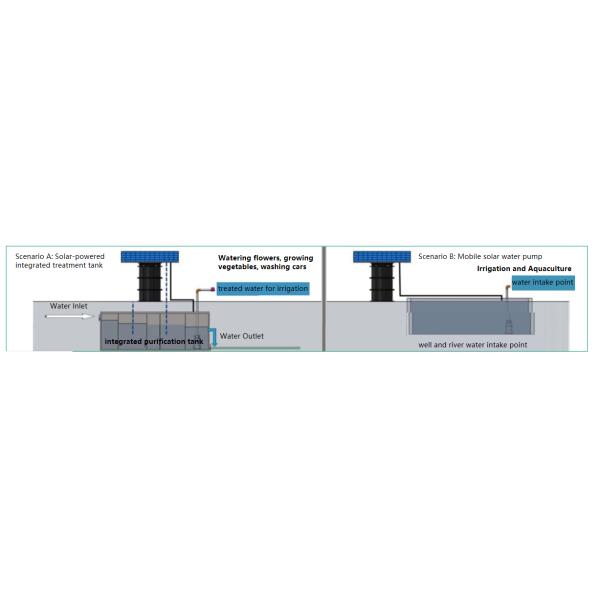
Diagram

|

